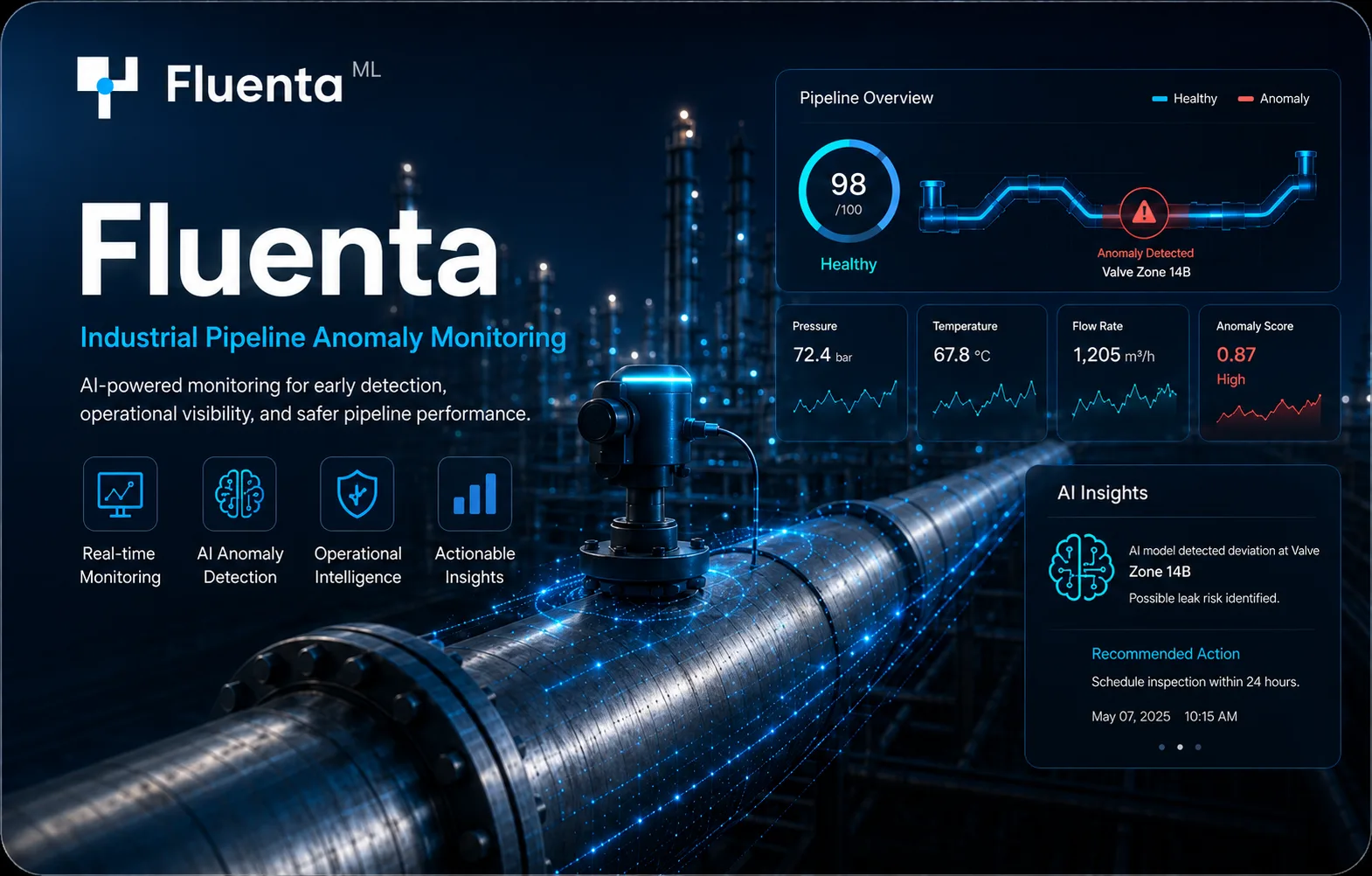
Fluventa - Industrial Pipeline Anomaly Alerting system
An evidence-oriented monitoring system that learns healthy pipeline behaviour, detects sudden and gradual deviations before resulting in severe damage/cost
- AutoEncoder
- FastAPI
- React
- Time-Series ML
- Domain-specifiML
Overview
Overview
Fluventa is an end-to-end pipeline anomaly-monitoring prototype designed to identify unusual operating behaviour at a monitored checkpoint.
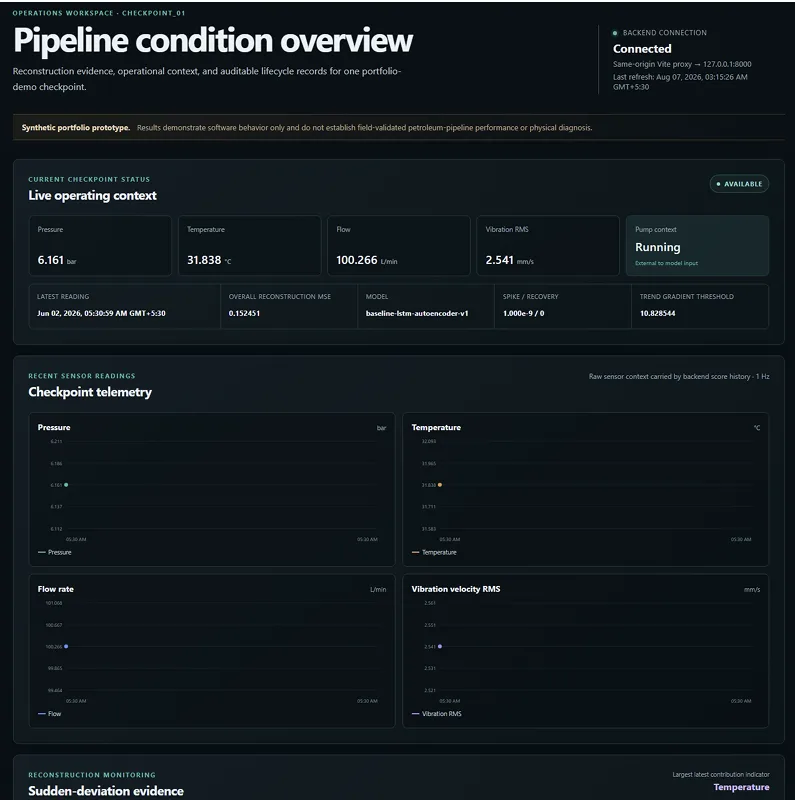
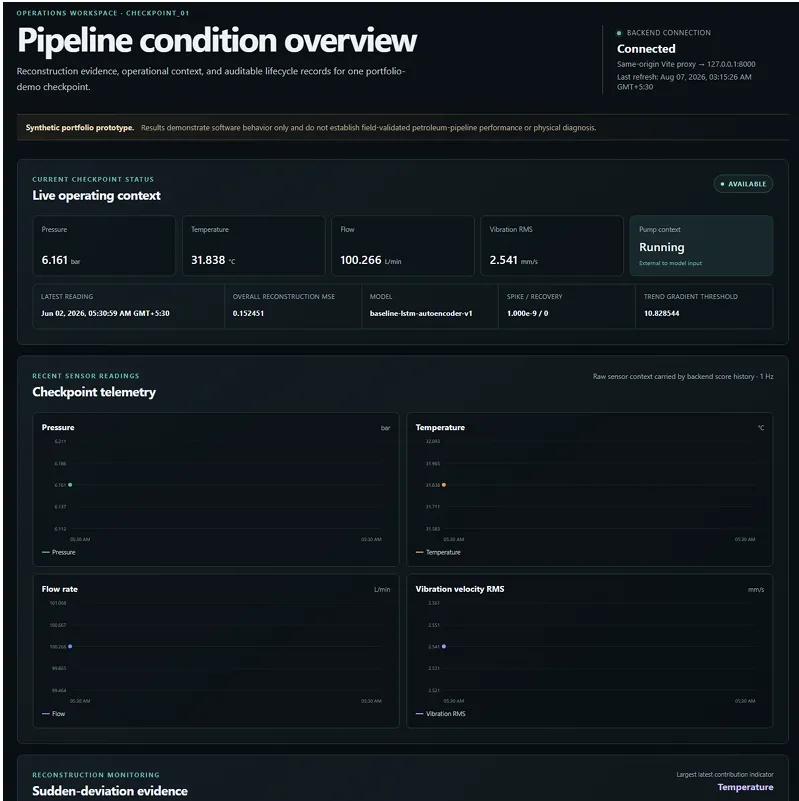
The system learns the normal relationship between pressure, temperature, flow, and vibration from approved healthy data. It then compares each new 60-second sensor window with that learned baseline and presents unusual behaviour as explainable evidence for human investigation.
How it works
- Sensor readings arrive once per second.
- Data-quality checks identify missing, frozen, duplicated, or invalid readings.
- The latest 60 readings are combined into a one-minute operating pattern.
- A healthy-only LSTM autoencoder measures how different that pattern is from normal behaviour.
- Separate monitoring paths evaluate sudden events and gradual deterioration.
- Operators can review, acknowledge, classify, and document the resulting records.
The machine-learning model detects deviations—it does not automatically diagnose leaks, blockages, or mechanical failures. Physical interpretation remains with qualified operators and engineers.
Key capabilities
- Healthy-only multivariate time-series learning
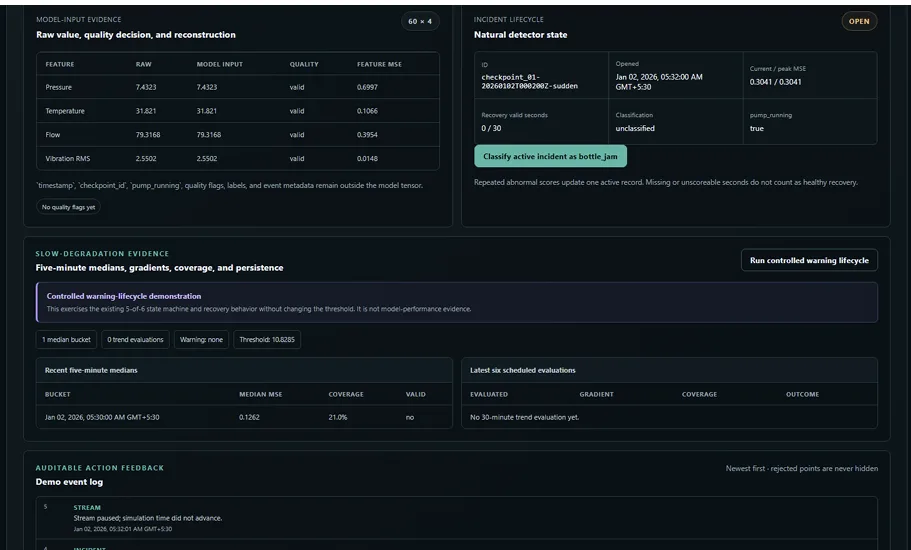
- Sudden anomaly detection and incident tracking
- Six-hour slow-degradation monitoring
- Per-sensor anomaly contribution evidence
- Short-gap handling and sensor-quality validation
- Recovery based on 30 consecutive valid healthy results
- Operator acknowledgement, classification, and notes
- Auditable model training, approval, deployment, and rollback
- Interactive dashboard and deterministic demonstration scenarios
- Local Windows deployment with a loopback-only backend
Architecture
The system combines a PyTorch LSTM autoencoder, Python preprocessing and detection services, a FastAPI backend, persistent incident records, and a responsive React/TypeScript dashboard.
The model processes 60-second windows containing four synchronized sensor signals. Fast and slow monitoring are deliberately separated because sudden operational changes and gradual deterioration require different time horizons and persistence rules.
Important design decisions
- Raw readings are preserved separately from processed model inputs.
- Missing or unreliable evidence produces a limited-monitoring state instead of a guessed result.
- Continuing abnormal scores update one active incident rather than creating duplicates.
- Missing data never counts as proof of recovery.
- Model artifacts, scaling rules, and thresholds are deployed as one versioned package.
- New models require explicit human approval and support controlled rollback.
- Operational context is displayed without automatically suppressing anomaly evidence.
My contribution
I designed and implemented the complete workflow, including data simulation, preprocessing, machine-learning architecture, anomaly rules, API services, incident lifecycle, model governance, dashboard experience, testing, packaging, and technical documentation.
I also created repeatable demonstration scenarios covering healthy startup, sudden anomalies, recovery, slow deterioration, unreliable sensors, incident classification, model deployment, and rollback.
Project scope
Fluventa is a synthetic portfolio prototype that demonstrates real software and machine-learning behaviour. It is not a field-certified pipeline safety system or an automatic physical fault-diagnosis solution.
The project demonstrates how machine-learning evidence can be made explainable, operationally useful, and accountable while keeping important decisions under human control.
Gallery
Interested in something similar?
I'm open to new projects and collaborations — let's build something great together.
Get in touch